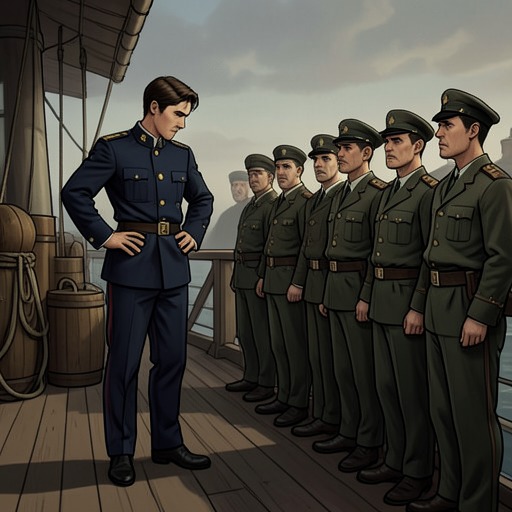
Lax discipline aboard the Caine
The Caine MutinyLax discipline aboard the Caine is a recurring condition of shipboard life, visible in sleeping or seated watchstanders and in the uneven enforcement of orders. It is not simply an absence of rules: the crew’s habits persist alongside formal authority, while the captain’s later drive for stricter control produces compliance that is often local and temporary. The contrast between careless routine, exhausted service, and moments of practical coordination makes discipline aboard the ship a negotiated condition rather than a settled standard.
Early Signs and Watchkeeping
When Willie Keith first encounters the ship’s living arrangements, Ensign Harding is asleep in a recently welded bunk inside the clipping shack, a small metal compartment whose temperature is about 105 degrees. The cramped, improvised setting establishes the physical conditions of daily life, though it does not itself explain the crew’s conduct. More directly, Willie’s first night watch exposes how far the crew’s habits depart from the expectations he learned at Furnald Hall.
A messenger, Mackenzie, sits on a crate of cabbages instead of remaining ready for duty. He argues that he is available if needed and claims that Captain de Vriess does not care whether sailors stand, while Willie suspects this is a false appeal to the captain’s supposed indifference. The gangway petty officer, Engstrand, watches the exchange with amusement. Willie threatens Mackenzie with a report, but his uncertainty shows that he has not yet learned how authority is ordinarily enforced aboard the Caine.
On the forecastle, Willie finds a guard asleep beside the anchor windlass, his rifle across his knees. When roused, the guard denies sleeping and offers an explanation that Willie does not accept. Willie considers placing him on report but hesitates over the responsibility of bringing the man before a court-martial; instead, he orders the guard to remain standing and not repeat the behavior. His response reveals a tension between enforcing wartime standards and avoiding a severe penalty for an offense he has just discovered.
The stern watch repeats the same pattern. Willie finds Mackenzie lying on life jackets and Engstrand sitting on a hatch, smoking. Mackenzie says he is sick after a difficult liberty, and Engstrand presents him as being in poor shape. When Willie returns, Mackenzie is asleep again and Engstrand has resumed sitting. Willie finally makes the petty officer responsible for keeping the messenger upright, and Mackenzie gets up and remains standing. The episode ends not with a formal report but with a limited accommodation: Mackenzie asks permission to smoke, and Willie allows it. Discipline is asserted, tested, and settled through immediate negotiation rather than through a lasting change in the ship’s habits.
Rules and the Circle of Compliance
Under Philip Francis Queeg, the ship’s lax routine meets an increasingly extensive system of orders and penalties. One order threatens heavy disciplinary action for the whole crew. After a cigarette butt is found in a forecastle scupper, Queeg cancels liberty for everyone. The deck force then keeps the main deck swept while the restriction is in force. Once the Caine sails for Kwajalein, the order is shelved and the deck becomes dirty again except during sweeping periods. A sailor is still assigned to clean the small patch between the captain’s cabin, the bridge ladder, and the hatch to the wardroom.
This selective obedience is described as a Circle of Compliance around the captain: rules are observed where his eyes and ears can reach, while much of the ship continues according to its previous habits. Queeg’s unexpected inspections or appearances can lead to new laws, but the crew’s observance remains concentrated within the area he is likely to monitor. The account stresses that this is not a conscious conspiracy. It is an established pattern of individual adaptation, one that allows the ship to look orderly in the captain’s presence without transforming its wider daily culture.
The crew’s response to Queeg is not uniform. General dislike coexists with intense hostility from sailors who have clashed with him, while some men regard him as a good captain so long as they keep out of his sight. Outside the circle of compliance, life is described as easier but also dirtier and less regulated, tempered by informal rules among the sailors and respect for a few officers, especially Steve Maryk. Thus the ship’s order is divided between official regulations, the captain’s limited sphere of enforcement, and a practical community order formed by the crew.
Hardship, Fatigue, and Administrative Control
The looseness of everyday discipline exists within a demanding routine of watches and maintenance work. During a period of rough weather, Willie moves repeatedly between bridge watches, coding, correcting publications, meals, and sleep in the clipping shack; rest is interrupted after only a few hours. The officers and sailors endure long watches and subdued meals, while the captain continues to roll steel balls in his fingers and makes occasional remarks about work requests. The account links shipboard routine to fatigue and confinement without suggesting that hardship excuses every breach of duty.
As the Caine’s service continues, Queeg’s control increasingly takes the form of reports, investigations, and restrictions. He confines sailors, places officers under arrest, cuts off water or coffee, and once suspends movies for the entire crew for six months because the operator failed to notify him that a showing was beginning. In another inquiry, officers remain in session for forty-eight hours trying to discover which mess boy had burned out a Silex; the cause is never established, and Queeg announces a twenty-point reduction in everyone’s fitness rating. These measures impose burdens without necessarily producing a more dependable shipboard culture.
The officers’ condition deteriorates alongside the escalating discipline. They average only four or five broken hours of sleep a night, become jumpy and quarrelsome, and grow increasingly distressed by the wardroom telephone and summonses to Queeg’s cabin. Meanwhile, Steve Maryk continues to add to a secret log. The contrast is significant: the captain demands written accountability on a growing scale, while Maryk privately records a pattern of conduct that the official system has not resolved. The crew’s laxity and the captain’s punitive administration therefore develop side by side, neither yielding a stable form of trust.
Seamanship and the Limits of Disorder
The ship’s informal culture does not mean that every duty is performed carelessly. During a watch, the forward fireroom requests permission to blow tubes. Steve Maryk grants it after checking the flag and explains that the wind will carry the soot clear; if the wind is wrong, the ship may have to change course, in which case the skipper’s permission is needed. The exchange presents routine competence based on observation and practical knowledge, distinguishing seamanship from mere rule-following.
The distinction becomes urgent during the typhoon. As a large wave strikes the bridge, Steve Maryk insists that the ship must turn into the wind, while the steering reports indicate that the Caine is not responding normally. Later, when a nearby vessel is sighted, Maryk orders the ship to circle the capsized vessel twice and directs all hands on deck to look for survivors. These moments do not erase the earlier failures of discipline, nor do they establish that the crew’s routine disorder caused the crisis. They show instead that daily laxity and emergency action are not identical: under immediate pressure, command can still organize a specific response.
The Caine’s discipline is therefore marked by a persistent gap between what the rules prescribe and what the ship actually does. Willie’s watch reveals neglect handled through improvised persuasion; Queeg’s regime turns that neglect into a target for broad punishment, yet often secures only visible, short-lived compliance. Against both, the crew’s practical customs and officers’ situational judgment remain consequential. The result is a ship whose order is neither simply absent nor reliably imposed, but continually shaped by authority, fatigue, observation, and the demands of the moment.